









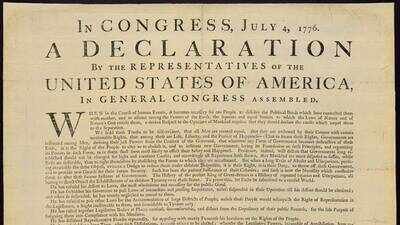
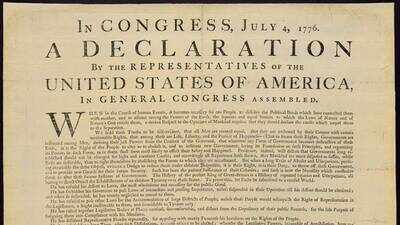
A rare copy of the Declaration of Independence, believed to have been lost for more than 250 years, has been discovered at Britain’s National Archives in London, making it the only known example of its kind to survive outside the United States.According to a press release issued by Britain’s National Archives, the document is one of just 11 known surviving copies of the so-called Exeter printing, produced in Exeter, New Hampshire, only days after the Declaration of Independence was adopted on July 4, 1776. The early printing was intended to spread news of American independence across the colonies.
Found during routine cataloguing project
The document was uncovered in May by volunteer researcher Michael Scurr while cataloguing records from the American Revolutionary War. According to The Associated Press, Scurr found the Declaration among papers belonging to Royal Navy captains that had remained untouched in the archives for centuries.“I thought, oh, right, this is definitely a Declaration of Independence. How exciting is this?” Scurr told The Associated Press, recalling the moment he realised the significance of the discovery.The National Archives said the Declaration was among documents seized by the Royal Navy in December 1776 after British forces captured the American privateer vessel Dalton.
A document that reflected the ideals of the Revolution
Amanda Bevan, who leads the National Archives’ project cataloguing Royal Navy correspondence from the American Revolution, told NBC News that the discovery adds an important new dimension to the story of the Dalton and other American privateer ships.“It was an amazing addition to the story of the Dalton and the many other privateers that fought the British at sea,” Bevan said.The seized collection also included the Dalton’s commission authorising it to attack British vessels on behalf of the Continental Congress, along with official instructions governing privateer conduct during the war.Bevan said such documents were often read aloud to crews to reinforce discipline. She added that she likes to imagine Captain Eleazer Johnson also read the Declaration of Independence to his sailors, helping explain the ideals they were fighting for.
Captured before completing its mission
According to Britain’s National Archives, the Dalton’s mission ended on Christmas Eve in 1776, when the 18-gun vessel commanded by Captain Eleazer Johnson was chased for seven hours before being captured by the 64-gun HMS Raisonnable, led by Captain Thomas Fitzherbert, off the coast of Portugal.Johnson and approximately 120 crew members were subsequently imprisoned in Plymouth, England. The Declaration was listed merely as “another paper” in the Royal Navy’s inventory before disappearing into the archives for more than two centuries.
Historians explain why it remained hidden
Nicholas Guyatt, professor of North American history at the University of Cambridge, told The Associated Press that the document’s historical importance was not immediately recognised by British officials at the time.“From the British perspective, it was simply another document seized among many others,” Guyatt said. “It was filed away, sent back to London and ultimately disappeared into the archives.”He added that the discovery highlights the continued importance of examining physical archives, noting that such collections can still produce remarkable historical finds that reshape understanding of major events.The discovery comes just ahead of the anniversary of the adoption of the Declaration of Independence on July 4, offering historians a rare glimpse into how news of American independence was circulated during the earliest days of the Revolutionary War.