








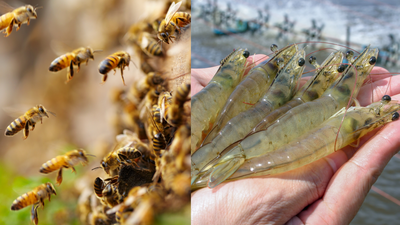
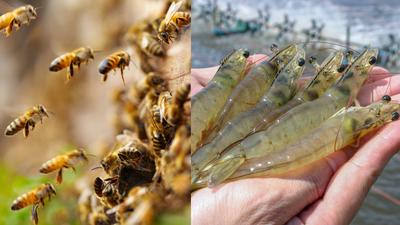
People, pets and livestock have long been protected through vaccines, but scientists are now extending that approach to creatures once thought impossible to immunise. Researchers have already developed the world’s first vaccine for honeybees and are testing similar technology in shrimp, despite the fact that these animals lack the antibody-based immune systems that conventional vaccines rely on. Instead, the new approach works by strengthening innate immunity and passing that protection to the next generation. Scientists believe the technology could help prevent devastating disease outbreaks, reduce reliance on antibiotics and safeguard industries worth billions of dollars. The developments are also reshaping long-held ideas about how immunity works in animals.Traditional vaccines train the adaptive immune system to produce antibodies and memory cells that recognise specific pathogens. Since insects and crustaceans do not possess this type of immune system, scientists long assumed vaccination was impossible.That view has changed over the last two decades. Studies have shown that invertebrates possess a form of “trained immunity”, in which previous exposure to microbes can alter immune responses in ways that provide longer-lasting protection. Researchers believe some of these changes are driven by epigenetic mechanisms and can even be passed to offspring.“For a long time, it was considered that vaccination couldn’t happen,” Erin Strait, veterinarian and chief scientific officer at Dalan Animal Health, told Science News. “That, in recent years, has been proven to not be true.”
How the world’s first honeybee vaccine works
In 2023, the US Department of Agriculture granted conditional approval to the first vaccine developed for an insect. Created by Dalan Animal Health, the vaccine targets American foulbrood, a deadly disease caused by the bacterium Paenibacillus larvae.Instead of injecting individual bees, scientists mix inactive bacteria into feed consumed by worker bees. The workers incorporate it into royal jelly, which is fed to the queen. Fragments of the bacteria eventually reach the queen’s ovaries, allowing her offspring to inherit greater resistance to the disease.A 2022 study titled The oral vaccination with Paenibacillus larvae bacterin can decrease susceptibility to American foulbrood infection in honey bees demonstrated that larvae from vaccinated queens showed improved protection against the disease.Honeybees are among the world’s most important pollinators, helping crops such as apples, almonds, blueberries and cucumbers reproduce. Their contribution to agriculture is worth billions of dollars each year, while the global beekeeping industry itself is valued at more than $10 billion.American foulbrood is particularly destructive because its spores can survive for decades. In severe cases, beekeepers are forced to burn infected hives to prevent the disease from spreading.Researchers have also reported an unexpected benefit. Speaking at the World Vaccine Congress in 2024, Dalan scientist Nigel Swift said colonies vaccinated against American foulbrood showed significantly lower levels of deformed wing virus, a major threat spread by varroa mites.
Shrimp are now becoming the next frontier
Following its success with honeybees, Dalan Animal Health has begun testing a vaccine for shrimp, one of the world’s most valuable aquaculture products. Diseases cost shrimp farmers billions of dollars annually, particularly early mortality syndrome and white spot syndrome virus.Unlike traditional vaccines, the shrimp version is fed to adult breeding animals, known as broodstock. Their offspring then inherit stronger resistance and are effectively born vaccinated.The company presented early findings at the 2026 World Vaccine Congress in Washington, DC. In laboratory tests, survival among shrimp exposed to Vibrio parahaemolyticus, which causes early mortality syndrome, increased from 27 per cent to 48 per cent. Survival against white spot syndrome virus improved from zero to 58 percent.
Scientists are optimistic but remain cautious
Experts say the early results are encouraging, but more evidence is needed before the shrimp vaccine can be judged a success.Arun Dhar, a crustacean infectious disease researcher at the University of Arizona, has spent years studying diseases in farmed shrimp. Speaking to Science News, he said he would like to see the findings published in a peer-reviewed journal before assessing their true potential.“Field data would really indicate the true efficacy,” Dhar said, noting that laboratory studies do not always reflect real-world conditions.Dalan plans to begin field trials in Southeast Asia, starting with Indonesia, where shrimp farming plays a major economic role.
Other insects and crustaceans could benefit too
Scientists believe the same principles could eventually be applied to other species important to agriculture. Christopher Williams, an applied entomologist at Liverpool John Moores University, has suggested that vaccines against silkworm diseases could be particularly useful.Researchers are also exploring ways to strengthen immunity in oysters, crabs and lobsters. In parallel, some studies have shown that probiotics may help silkworms defend themselves against Beauveria bassiana, a fungus capable of destroying entire colonies.
A new chapter in immunology
The emergence of vaccines for honeybees and shrimp is challenging one of biology’s oldest assumptions: that immune memory belongs only to animals with antibodies. Scientists now recognise that innate immunity is far more sophisticated than previously believed.If ongoing trials prove successful, these vaccines could do more than protect bees and shrimp. They could reduce antibiotic use, limit disease outbreaks and open an entirely new branch of animal medicine, showing that even creatures once considered impossible to vaccinate can benefit from immune training.