








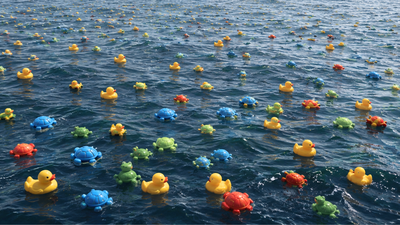
A cargo ship crossing the North Pacific encountered a powerful storm that swept several shipping containers into the ocean. One of those containers carried 28,800 plastic bath toys consisting of yellow ducks, blue turtles, red beavers, and green frogs. What appeared to be a routine shipping accident soon turned into one of the most unusual scientific experiments in history. As the toys drifted across oceans for years, researchers tracked their movements and used the information to gain a deeper understanding of how ocean currents move around the planet. The accidental spill provided scientists with valuable data that would have been extremely difficult and expensive to collect through traditional methods.
The day 28,800 bath toys disappeared at sea
On January 10, 1992, the cargo ship Ever Laurel was sailing from Hong Kong to Tacoma, Washington, when it encountered severe weather in the North Pacific near the International Date Line. Powerful waves knocked twelve shipping containers overboard during the storm.One of those containers held 28,800 plastic bath toys manufactured for children. The shipment included 7,200 yellow ducks, 7,200 blue turtles, 7,200 red beavers, and 7,200 green frogs. Eventually, the container broke open and released its contents into the Pacific Ocean.Unlike many bath toys, these toys had no holes. They were completely sealed, which meant they could float for years without filling with water. This characteristic would later make them ideal for studying the movement of ocean currents.Most shipping accidents disappear from public memory within days, but this one attracted the attention of oceanographers. Scientists realized that thousands of identical floating objects had entered the ocean at the same location and time, creating a rare opportunity to study the movement of surface currents.Among those fascinated by the spill was oceanographer Curtis Ebbesmeyer, who began collecting reports of recovered toys from beachcombers and coastal communities. Every toy that washed ashore offered a clue about the path it had taken through the ocean.By comparing these discoveries with existing current models, researchers could test and refine their understanding of how water moves across vast distances.
Following the Pacific’s invisible highways
After entering the Pacific Ocean, the toys quickly dispersed. Some drifted northward and began appearing along the coast of Alaska within a year. Others became trapped in the North Pacific Gyre, a massive circular system of currents that continuously moves water and floating debris around the ocean basin.Over time, sightings were reported from Hawaii, Japan, and the western coast of North America. The toys followed routes that closely matched the predictions made by oceanographers, confirming that their models were largely accurate.The spill provided a real-world demonstration of how ocean currents function as invisible highways, carrying floating objects across thousands of kilometers.
A surprising journey through the Arctic
One of the most remarkable aspects of the bath toys’ voyage involved the Arctic Ocean. Scientists predicted that some of the toys would travel north through the Bering Strait and become trapped in Arctic sea ice.As the ice drifted across the Arctic, the toys moved with it. Years later, when the ice melted, many were released back into open water and carried into the North Atlantic.This unexpected route helped researchers better understand the connection between the Pacific and Atlantic Oceans. It also revealed how sea ice can transport floating debris across enormous distances.
Reaching distant shores
The bath toys continued their journey for years after leaving the Pacific. Some eventually appeared along the eastern coast of North America, while others were found on European beaches.Scientists estimated that certain toys may have traveled more than 27,000 kilometers, or approximately 17,000 miles, during their decades-long voyage. Few people could have imagined that simple plastic bath toys would end up crossing entire oceans and reaching coastlines thousands of miles from where they entered the sea.These discoveries highlighted just how interconnected the world’s oceans really are.
What scientists learned
The Friendly Floatees spill became an important case study in oceanography. By tracking the toys, researchers gained valuable insights into the behavior of ocean currents, the movement of floating debris, and the role of large ocean gyres.The findings helped improve computer models used to predict the movement of water across the globe. Scientists also learned more about how debris travels through the Arctic and eventually enters other ocean basins.The spill demonstrated that ocean currents are not isolated systems. Instead, they form a vast network that connects distant regions of the planet.
A lesson about plastic pollution
Although the bath toys proved useful for scientific research, the incident also highlighted a growing environmental concern. The toys survived for decades because they were made from durable plastic materials that resist degradation.Their long journey showed how plastic waste can persist in marine environments and travel extraordinary distances. What entered the ocean in one location eventually appeared on beaches thousands of kilometers away.This realization helped raise awareness about the global nature of plastic pollution and the challenges involved in cleaning up marine debris.
The legacy of the Friendly Floatees
More than three decades after the accident, the story of the Friendly Floatees remains one of the most fascinating examples of accidental scientific discovery. What began as a shipping mishap became a unique large-scale experiment that helped researchers better understand the oceans.The floating ducks, turtles, frogs, and beavers revealed hidden pathways beneath the waves and demonstrated how connected the world’s oceans truly are. Their unexpected voyage transformed a simple cargo accident into a scientific story that continues to captivate researchers and the public alike.Sometimes, the greatest discoveries are not planned. They simply drift into history.