








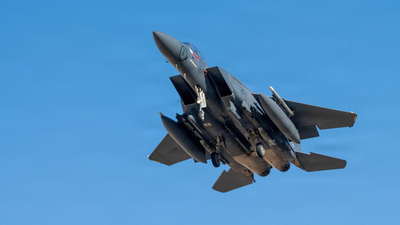
The US F-15E Strike Eagle shot down over southwestern Iran last month was likely struck by a Chinese-made shoulder-launched missile, according sources cited by NBC.US officials are still investigating the circumstances surrounding the April shootdown, which marked the first time in decades that a US fighter aircraft was brought down by enemy fire.At the time, President Donald Trump said the aircraft had been hit by a shoulder-launched missile. The weapons, commonly known as man-portable air defense systems, or Manpads, are about seven feet long, weigh roughly 40 pounds and are widely used to target low-flying aircraft.The two crew members aboard the F-15 safely ejected over Iran. According to the Pentagon, the pilot was rescued within seven hours, while the weapons systems officer was located and rescued two days later after hiding in the foothills of the Zagros Mountains. Officials said it is unclear whether the missile believed to have brought down the F-15 was recently delivered or came from older Iranian stockpiles.Responding to questions about the F-15 incident, a spokesperson for the Chinese Embassy said: “China always acts prudently and responsibly on the export of military products, and exercises strict control in accordance with China’s laws and regulations on export control and due international obligations. China opposes groundless smear and ill-intentioned association.”In the early days of the conflict, China may have provided Iran with a long-range early-warning radar capable of detecting stealth aircraft designed to evade detection, according to one of the sources and a US official familiar with the matter. It remains unclear whether the radar system, known as the YLC-8B, was deployed during the war.The Trump administration has also accused China of supporting Iran through satellite services. Earlier this month, the State Department imposed sanctions on three Chinese satellite companies, alleging they provided imagery and data that helped Iran target US forces in the Middle East. China denied the allegations.Despite those concerns, a US official familiar with the discussions told NBC News that any Chinese assistance had little effect on the battlefield.“It was not significant support. There was no decisive operational impact to it,” the official said.The reported use of Chinese-made military equipment by Iran has added a new dimension to US-China relations at a time when officials from US and Iran are seeking an end to the conflict. Negotiations remain underway even as the US continues what it describes as “defensive” strikes.The Trump administration brokered a ceasefire with Iran ahead of a key meeting with President Xi Jinping earlier this month. China, the main buyer of Iranian oil exports, has repeatedly called for an end to the war.“We are not immune to global oil prices at some point, because we do buy from the global market, but other countries around the world are paying a much higher price,” secretary of state Marco Rubio said during a trip to China. “They’ve got to get involved in this as well.”However, Rubio rejected the suggestion that Washington was depending on Beijing’s assistance, saying, “We’re not asking for China’s help. We don’t need their help.”China supplied Iran with large quantities of military equipment during the 1980s and 1990s, including ballistic missiles, anti-ship missiles, tanks, artillery and fighter jets.After a United Nations arms embargo was imposed on Iran in 2006, China reduced major weapons sales and instead provided components and technologies with both civilian and military applications, according to experts and the Stockholm International Peace Research Institute. Iran subsequently expanded its domestic weapons production industry.Experts say China has continued to provide Iran with economic support despite US sanctions. Craig Singleton, senior director of the China program at the Foundation for Defense of Democracies, said Beijing has also helped Iran strengthen its domestic surveillance systems and sustain its military through technology transfers and other dual-use items.