








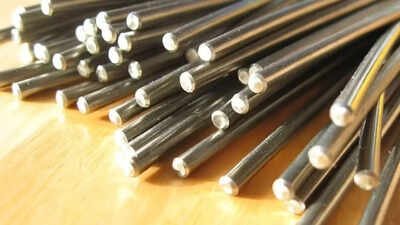
Inside factories, data centres and power plants, heat is usually treated as a problem rather than a resource. It drifts away in plumes, warms the surrounding air, and disappears into the atmosphere with little thought given to its potential. Yet some engineers are now circling back to that wasted energy and asking a slightly unusual question: what if a metal that remembers its shape could help turn it into electricity?The idea sounds almost indirect at first. Not a turbine, not a solar panel, but a wire that bends, relaxes, and returns to form over and over again. This so-called shape memory metal, often linked to nitinol, when in 1959 has been studied for decades in medicine and engineering. But its role in energy systems is only just beginning to be explored in any serious way. And while expectations are cautious, there is growing interest in whether small physical tricks like this might ease parts of a much larger electricity challenge unfolding across the world.
The strange shape-memory metal that bends, twists and returns to form
As reported by Berkeley Lab, Nitinol, a nickel-titanium alloy, does not behave like ordinary metal. It can be bent far more than steel or copper without breaking its structure, then recover its original shape when conditions change. That response is tied to temperature shifts and internal rearrangements in its crystal structure. It was originally developed in the late twentieth century for specialist applications, and later found its way into medical tools and orthodontics. The reason is simple enough: it can flex repeatedly without permanent damage. Engineers sometimes describe it as a material that “remembers” where it started, although that description only loosely captures what is happening inside it. What makes it interesting for energy discussions is not its memory alone, but the motion it produces when repeatedly pushed through heating and cooling cycles.
How waste heat from industry could become a new energy source
Across industry, vast amounts of heat are produced as a by-product of normal operation. A significant share of global energy use, some estimates suggest, ends up as waste heat that is never reused. Much of it is low-grade, meaning it is warm rather than hot, which makes it difficult to capture efficiently using conventional systems.This is where nitinol begins to attract attention. When exposed to changing temperatures, it contracts and expands in a repeatable cycle. That movement can, in theory, be converted into mechanical energy and then into electricity. The principle is not new, but the challenge has always been scale and efficiency. Turning small physical motion into useful electrical output without losing most of it in conversion steps is not straightforward. Even so, materials scientists appear increasingly willing to revisit older ideas with improved engineering tools.
The hidden weaknesses behind shape-memory energy technology
There are practical barriers that cannot be ignored. Nitinol systems require precise temperature control to maintain cycling motion, and that is not always available in real-world environments where heat levels fluctuate unpredictably. Durability is another question. Repeated thermal cycling places stress on materials, and long-term performance data is still limited compared with established energy technologies. Efficiency losses during conversion from mechanical motion to electricity also remain a concern.Experts suggest that even if the concept works, it is unlikely to replace large-scale generation methods. Wind, solar and nuclear power still form the backbone of long-term energy planning in most scenarios being considered today.