








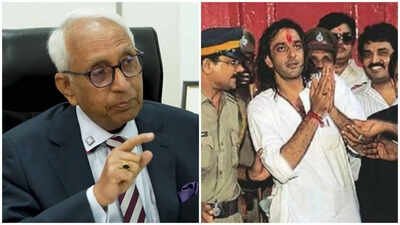
Former Mumbai Police officer MN Singh has revisited one of the most controversial chapters of the 1993 Mumbai blasts investigation — the arrest of Sanjay Dutt — recalling the pressure, politics and legal complexities surrounding the case.Speaking to Hussain Zaidi on his YouTube channel, Singh said the case stood out because “before this, no film star had been arrested. It was the first time,” adding that the situation came with “so much pressure,” including from the actor’s MP father Sunil Dutt.
‘He admitted… but said it was a mistake’
Singh revealed that the investigation pointed to Dutt procuring weapons during the 1993 riots, allegedly sourced via underworld operatives linked to Dawood Ibrahim and delivered by Abu Salem on instructions from Anees Ibrahim.“When it came out in our investigation that Sanjay Dutt had taken weapons, it shocked everyone — even us,” Singh said.He added that Dutt admitted to possession during questioning: “He said, ‘Sahab maine liya, lekin galti ho gayi.’”The actor had reportedly cited threats during the riots as the reason for acquiring the weapons — a claim that has also been part of public record over the years.However, Singh pointed out that Dutt already had licensed weapons and police protection. “These were not for safety,” he said, noting the cache included “AK-56 rifles, ammunition and hand grenades.”
‘What could I do? He was a star, so let him go?’
Despite the shock factor, Singh maintained that the law had to take its course. “What could I do? Should I have let him go because he was a star? That was not possible,” he said.He also recalled repeated appeals from Sunil Dutt. “He would meet me and say, ‘Singh saab, bachaiye mera ladka… galti kar diya,’” Singh shared, adding that the scale of the case made it impossible to suppress.
The case: From TADA charges to Arms Act conviction
For context, Sanjay Dutt was initially arrested in 1993 under both the TADA and Arms Act in connection with weapons linked to the Mumbai blasts.While he was later cleared of terror charges, he was convicted under the Arms Act for illegal possession of weapons — including an AK-56 rifle — and eventually sentenced to five years in prison by the Supreme Court.
‘Those who gave weapons were convicted under TADA…’
Without directly criticising the judiciary, Singh hinted at his dissatisfaction with the outcome. “We had registered the case under TADA… charges were framed, trial had begun,” he said.He pointed out that several others involved — including those who delivered the weapons — were convicted under TADA. “Those who gave the weapons were punished under TADA… the one who took them was not,” he remarked, adding, “I don’t want to comment further.”
‘Pressure was there, but I didn’t bend’
Singh also revealed that multiple officials — including police and customs officers — were booked in the case, and that pressure came from “top to bottom.”“As an officer, it was my duty. In such a big case, giving protection to anyone is not in my nature,” he said, asserting that he did not allow interference at his level.Ending on a guarded note, Singh added, “Whether there was pressure on the court or not, I cannot say… those who understand, will understand.”