





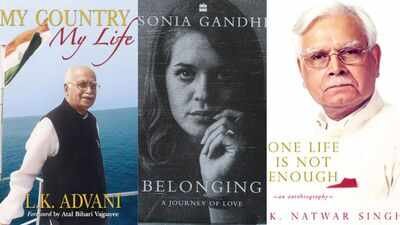
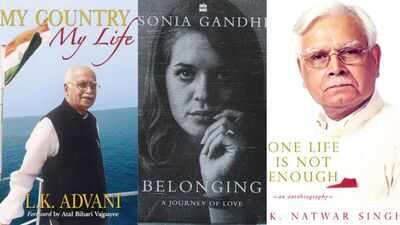
“I will write my own book and then you will come to know everything.”Sonia Gandhi’s response to former external affairs minister Natwar Singh’s explosive autobiography in 2014 was as much a promise as it was a rebuttal. Singh’s book had stirred a political storm with its account of why she declined the prime minister’s post after the Congress-led UPA won the 2004 general elections. More controversially, he claimed that Rahul Gandhi had strongly opposed his mother’s elevation, fearing she could meet the same fate as her husband, Rajiv Gandhi, and mother-in-law, Indira Gandhi, both of whom were assassinated. Sonia, who had publicly attributed her decision to her “inner voice”, was now promising to tell her side of the story.Twelve years later, that promise has come full circle. Sonia Gandhi’s memoir, Belonging: A Journey of Love, was released on November 10, bringing her own account of her life, family and political journey into the public domain. The book has already triggered political reactions and renewed debate over some of the most contentious episodes involving the Gandhi family.But Sonia is hardly the first political figure to find that putting personal recollections on paper can have consequences far beyond the pages of a book. Over the years, memoirs by politicians have revisited ideological battles, exposed differences within parties, offered personal accounts of political turning points and reopened controversies that many thought had been settled.From L K Advani’s account of the Jinnah controversy to Jayaprakash Narayan’s prison diary during the Emergency, these books have offered glimpses into the people and decisions behind some of India’s defining political moments.Here are five political memoirs that made headlines for what their authors chose to reveal.
Natwar Singh’s One Life Is Not Enough
When Natwar Singh’s autobiography was released in 2014, much of the attention centred on his account of Sonia Gandhi’s decision not to become prime minister in 2004.While Sonia had publicly described the decision as a call of her “inner voice”, Singh offered a different explanation. He claimed that Rahul Gandhi had strongly opposed his mother’s elevation, fearing that she could meet the same fate as her husband, Rajiv Gandhi, and mother-in-law, Indira Gandhi, both of whom were assassinated.Singh wrote that Rahul’s opposition was so strong that he gave Sonia 24 hours to decide. He also claimed that he, Manmohan Singh, Suman Dubey and Priyanka Gandhi were present when Sonia struggled with the decision. According to him, Rahul’s intervention ultimately led her to offer the post to Manmohan Singh.The memoir went beyond the 2004 episode. Singh offered a sharply critical assessment of Sonia’s leadership and her control over the Congress, describing her as increasingly authoritarian and secretive. He also recounted conversations with former prime minister P V Narasimha Rao, who, according to Singh, was troubled by Sonia’s attitude towards him.The revelations triggered a political storm. Sonia rejected Singh’s account and announced that she would write her own book. Former prime minister Manmohan Singh dismissed the claims as a “marketing gimmick”, while the Congress accused Natwar Singh of distorting facts to promote his book.The controversy deepened when Singh made remarks linking Sonia’s alleged ruthlessness to her Italian origin, drawing further criticism.
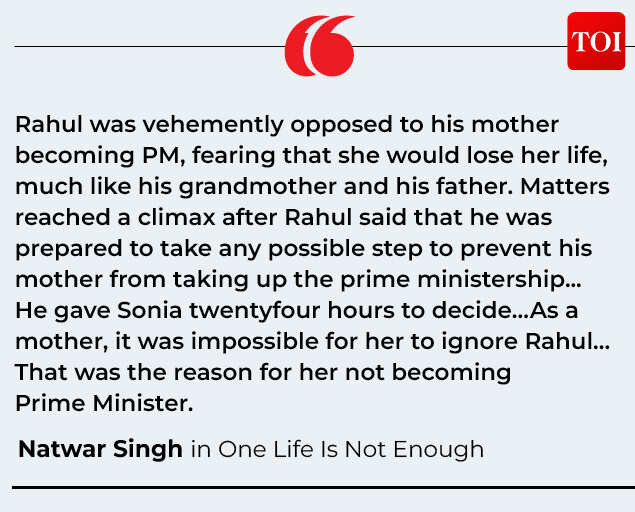
Natwar Singh on Rahul Gandhi’s role in Sonia’s decision not to become PM
LK Advani’s My Country, My Life
Released in New Delhi on March 19, 2008, by then President A P J Abdul Kalam, L K Advani’s autobiography traced his journey from childhood in Karachi and Partition to his association with the RSS, the growth of the BJP, the Ram Janmabhoomi movement and his years in the Union government.One of its most discussed sections revisited the controversy surrounding Advani’s June 2005 visit to Pakistan and his remarks on Muhammad Ali Jinnah. During the visit, Advani praised Jinnah’s August 11, 1947, address to Pakistan’s Constituent Assembly, in which the latter spoke about religious freedom and equal citizenship irrespective of religion.The remarks triggered a backlash within the BJP and the Sangh Parivar. Sections of the party viewed them as a departure from its ideological position, and Advani eventually resigned as BJP president.Looking back at the episode, Advani described it as “simply the most agonising moment of my political life”. He also recalled feeling let down by several party colleagues during the controversy, contrasting their response with the support he had received during the Hawala case in 1996.Explaining the purpose of his Pakistan visit, he wrote: “I went to Pakistan as a messenger of peace, with an earnest desire to contribute to the normalisation of relations between our two long-estranged nations.”Advani maintained that he had not described Jinnah as secular but had referred to a particular speech as a “classic, a forceful espousal of a Secular State”. He also argued that the media had reported his remarks without adequately explaining their historical context.The autobiography also revisited the 1990 Rath Yatra and the demolition of the Babri Masjid on December 6, 1992. Another section offered insights into his long association with former prime minister Atal Bihari Vajpayee. While acknowledging that the two sometimes differed in their approaches, Advani wrote that he had always regarded Vajpayee as his leader and generally deferred to his opinion.
Mamata Banerjee’s My Unforgettable Memories
Published in January 2012 by Roli Books, Mamata Banerjee’s My Unforgettable Memories offered a personal account of the relationships, disappointments and political rivalries that shaped her career. The English book was a translation of excerpts from her earlier Bengali writings.It appeared just months after Mamata led the Trinamool Congress to a historic victory in the 2011 West Bengal assembly elections, ending the Left Front’s 34-year rule. Her observations about prominent political figures, particularly Sonia Gandhi and Rajiv Gandhi, attracted considerable attention.Having spent years in the Congress before leaving the party to establish the Trinamool Congress in 1998, Mamata wrote about feeling repeatedly let down by its leadership. She referred to Sonia Gandhi as the “Queen Mother” and criticised the party’s treatment of regional leaders.“The culture in Congress is that when a regional faction gets too active, it’s immediately censored by the top leadership,” she wrote.Her account of Sonia, however, stood in contrast to the affection she expressed for Rajiv Gandhi, whom she described as “the leader of our hearts”.Mamata recalled that after she was attacked at a rally in Kolkata in 1991 by alleged CPM activists, Rajiv took responsibility for arranging and paying for her treatment. He also sent people to ask whether she wanted to travel to the US for further medical care.She wrote that she was devastated when she heard of Rajiv’s assassination in May 1991. She said she could neither eat nor speak to anyone for a week and described the loss as being “orphaned all over again, for the second time in my life since my father’s death”.The memoir also spoke warmly of former President Pranab Mukherjee, despite the changing political equations between the Congress and the Trinamool Congress.“I have always respected him and my relationship with him is that of an elder brother and his kid sister,” she wrote.She recalled that when Mukherjee was sidelined by the Congress and formed the Rashtriya Samajwadi Congress in 1986, she had repeatedly requested Rajiv Gandhi to take him back into the party.
Jayaprakash Narayan’s Prison Diary
Unlike the other books, Jayaprakash Narayan’s Prison Diary was not a retrospective account written years after the events. It was a record of his experiences during one of the most turbulent periods in India’s democratic history: the Emergency.Popularly known as JP, Narayan was among the most prominent leaders of the movement against Indira Gandhi’s government in the 1970s. His call for Sampoorna Kranti (Total Revolution) had brought together students, opposition parties and civil society groups.After the Allahabad high court set aside Indira Gandhi’s election from Rae Bareli on June 12, 1975, the movement gathered momentum. On June 25, JP addressed a massive rally at Delhi’s Ramlila Maidan, calling for a peaceful struggle against the government. Hours later, the Emergency was proclaimed. In the early hours of June 26, opposition leaders, including JP, were arrested.Written during his detention and published by Popular Prakashan in 1977, the diary documented his experiences in custody, his health, his reading and his reflections on the political crisis.One of its most striking passages appeared in the opening entry, dated July 21, 1975, nearly a month after his arrest. JP wrote, “My world lies in a shambles all round me.”He went on to express disbelief that a democratically elected prime minister could use the law to undermine democracy and suppress political opposition. The diary also contained sharp criticism of the decision to impose the Emergency, arrest opposition leaders and curtail civil liberties.Another deeply personal aspect of the book was its account of JP’s deteriorating health. He was 72 when arrested and was already facing health problems. During his detention, his kidneys failed. He was released on November 12, 1975, on medical grounds and subsequently required regular dialysis for the remaining years of his life.Published in the year the Emergency ended and the Janata Party came to power, Prison Diary offered a contemporary first-person account of the political crisis from one of its most prominent opponents.
Pranab Mukherjee’s The Presidential Years
Former President Pranab Mukherjee’s The Presidential Years (2012-2017) made headlines even before its release in December 2020. The book offered his assessment of the Congress’s decline, his dealings with Prime Minister Narendra Modi and some of the most consequential decisions taken during his presidency.Looking back at the Congress’s defeat in the 2014 Lok Sabha elections, when the party won just 44 seats, Mukherjee attributed its performance to several factors, including its failure to recognise the end of its charismatic leadership. He described the establishment as having been reduced to a “government of averages”.
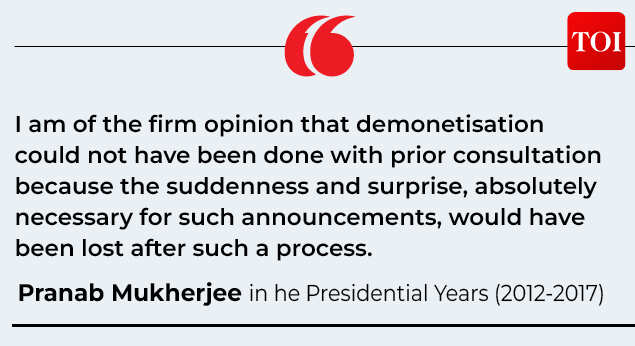
Why Pranab Mukherjee defended demonetisation without prior consultation
His observations also touched upon the Congress’s leadership under Sonia Gandhi and Manmohan Singh.The memoir was equally candid about his interactions with Modi during his five-year tenure as President. Mukherjee described their relationship as cordial and said he had regularly offered the prime minister advice on policy matters. However, he criticised the NDA government’s handling of Parliament between 2014 and 2019, blaming its “arrogance and inept handling” for the acrimonious exchanges between the treasury and opposition benches, while holding the opposition responsible too.One of the most discussed revelations concerned demonetisation. Mukherjee disclosed that Modi had not consulted him before announcing the decision on November 8, 2016. He said the lack of prior consultation did not surprise him, as the element of surprise was essential to such an announcement.He recalled that Modi visited Rashtrapati Bhavan after announcing the decision and explained its rationale. Mukherjee described demonetisation as a bold step but warned that it could cause a temporary economic slowdown and that the government would have to be careful about easing the burden on the poor.The memoir also became the subject of a family disagreement. Mukherjee’s son, former Congress MP Abhijit Mukherjee, asked the publisher to halt publication until he had reviewed the final manuscript and given written consent. His daughter Sharmistha Mukherjee opposed the demand, saying their father had completed the manuscript before falling ill and that the final draft retained his handwritten notes and comments.
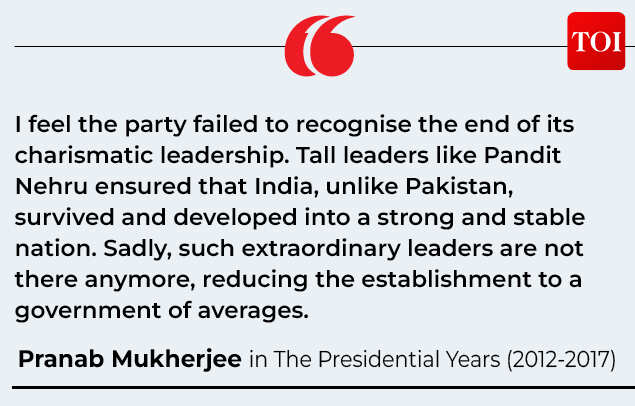
Pranab Mukherjee on the decline of charismatic leadership in Indian politics
Accusing her brother of creating “unnecessary hurdles”, Sharmistha said preventing the book’s release would be the “greatest disservice” to their departed father. The disagreement played out on social media, adding a family feud to the political conversations surrounding the memoir.
Share your thoughts in the comments
Be respectful · TOI community guidelines
Political memoirs offer a rare window into the personal experiences and perspectives of those who have occupied positions of power. They can reveal ideological differences, internal party dynamics and relationships that rarely find space in official accounts.But they are also personal interpretations of history. The authors decide which episodes to revisit, which conversations to disclose and how to explain decisions made years earlier. And, as the controversies surrounding these books show, sometimes what a politician writes long after leaving office can reopen debates that their public life had never quite settled.