






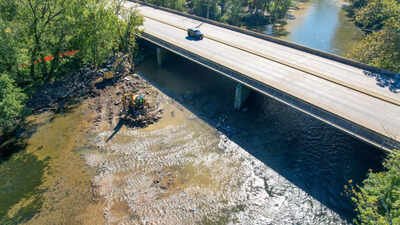
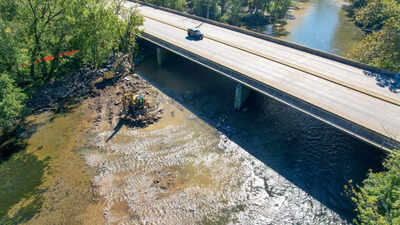
For the first time in almost 150 years, water is free-flowing through a stretch of Brandywine Creek in Chadds Ford, Pennsylvania. This is because excavators have now removed a dam built to power a mill that has since been converted into a museum. The dam once turned a wheel for Hoffman’s Mill. Today, with the mill a museum, its main work was blocking fish, trapping debris and worsening floods. Chadds Ford finally decided to let it go. Talk about moving on from a stuck relationship.Hoffman’s Mill Dam was built in the late 19th century to divert water into a mill race that powered Hoffman’s Mill, now part of the Brandywine Museum of Art. The mill wheel remained active until the mid-20th century, but the dam later served no functional purpose. It had already been breached on its western side, but much of the structure remained in the creek, continuing to affect the natural movement of water.Excavators removed the dam’s rocks and boulders on October 6, 2026, just north of the Route 1 overpass along the Brandywine Conservancy Trail. Project manager Rob Daniels said the removal restored free-flowing water to a section of the creek that had not experienced it for about 150 years.The Conservancy identified the structure as a low-head dam, a type of dam that can be particularly hazardous despite its relatively small height. The costs of keeping it in place had begun to outweigh any remaining benefit. Such dams can endanger paddlers, forcing canoeists and kayakers to carry their boats around them. They can also block fish movement, trap sediment over riffles and collect debris carried downstream during storms.There is more to the problem than simply interrupting the flow of water. When water sits behind a dam, it can become warmer and hold less dissolved oxygen, affecting the aquatic life that depends on it. Fish that would ordinarily move freely through the creek may also find their routes blocked. Over time, this can change the character of the habitat, particularly in shallow, fast-moving sections of a stream.The removal is expected to eliminate hazards for paddlers, tubers and people wading in the creek. It also encourages recreational activities by removing the need to carry boats around the dam. More importantly, it is expected to help reopen fish migration routes and restore shallow, fast-moving riffle habitats. These areas are important for several aquatic species, providing suitable conditions for feeding and other everyday activities. The removal could also improve water quality and reduce flooding.Conservancy director Grant DeCosta said the dam had exacerbated flooding in Chadds Ford and downstream, a concern reinforced by the Brandywine Flood Study and heightened by the aftermath of Hurricane Ida. The storm, which caused widespread flooding in the region in 2021, brought renewed attention to how infrastructure along waterways can influence the movement of floodwater. Removing the dam is therefore not just an ecological decision, but also part of a larger effort to make the creek and surrounding communities more resilient to flooding.
Why did it take six years to remove the dam?
The idea of removing the dam was first explored in 2020, but getting an old structure out of a waterway is not quite as simple as bringing in excavators and clearing the rocks. The project required engineering assessments, environmental reviews, permits and coordination with several organisations.The Brandywine Conservancy began evaluating the dam in 2020 and concluded that its removal would support its conservation mission. Between 2020 and 2024, the organisation secured funding and selected engineering firm Ramboll through a competitive bidding process.From 2024 to 2026, Ramboll worked on the design, permitting and stakeholder coordination. This also involved habitat assessments, particularly for red-bellied cooters and bog turtles, both species of conservation concern. Their presence meant that the timing and execution of construction needed to account for local wildlife.Physical removal finally began in October 2026, with Stonewood Landshaping appointed as the contractor and Ramboll overseeing construction. The work was expected to take approximately two weeks, with completion planned for mid-October.There was also a fairly narrow window for construction. Crews waited until after Labor Day, when most recreational paddlers had left the creek, but needed to finish before turtles began hibernating around October 15. This meant that the project had to balance public access, construction requirements and the needs of wildlife.
Funding and partners
Removing the dam required financial backing and coordination across several organisations. The project received funding from the National Fish and Wildlife Foundation, with additional support from the US Fish and Wildlife Service, the Pennsylvania Department of Conservation and Natural Resources (DCNR), Chadds Ford Township and Pennsbury Township.Ramboll was responsible for the engineering design and construction oversight, while Stonewood Landshaping carried out the physical removal. Several other organisations were involved in making sure the work could proceed without disrupting surrounding infrastructure. These included PennDOT, PECO, East Penn Railroad and TC Energy. Local townships, historical societies and county planning departments also provided input during the permitting process.The Conservancy has also made efforts to document what existed before the removal. It photographed and recorded the dam, reviewed potential historical and archaeological resources, and is developing educational material about its history. It is also exploring ways to reuse some of the materials recovered from the structure.The project is not about erasing local industrial history. Hoffman’s Mill was once an important part of the area’s working landscape, and the dam played a role in keeping it running. But infrastructure has a lifespan, and sometimes the purpose it was built for disappears while its environmental costs remain. Nearly 150 years later, Brandywine Creek is finally getting a chance to flow without it.