







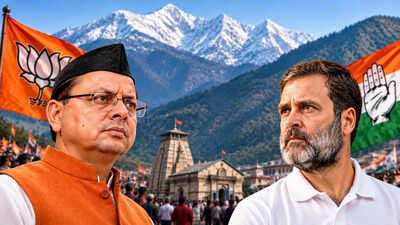
The hills have eyes.And no one needs to remember that more than the parties aiming to win Uttarakhand’s upcoming elections next year.The Pushkar Singh Dhami-led BJP government, has on more than a few occasions proclaimed that they are set to aim for a historic ‘hat-trick’ in the ‘Devbhoomi’. At a recent event in Dehradun, Union home minister Amit Shah set an ambitious target of winning more than 65 of the state’s 70 assembly seats. He said the BJP was determined to return to power for a third consecutive term and ensure that the “voice of Uttarakhand” reaches Congress leader Rahul Gandhi.But can the BJP script another first by securing a third consecutive term in a state where governments traditionally changed every five years? Or can the Congress capitalise on anti-incumbency against the Dhami government to wrest back power and add another state to its tally?The BJP enters the election contest on the back of a historic victory in 2022, when it won 47 of Uttarakhand’s 70 assembly seats to secure a second consecutive term for the first time since the state’s formation in 2000. However, the victory came with some caveats. The party’s tally fell sharply from the 57 seats it had won in 2017, while the Congress improved its count from 11 to 19. Although the BJP retained a comfortable majority, both its seat tally and vote share declined. The Congress, meanwhile, made gains but failed to mount a serious challenge to the BJP’s hold on power.That gap between retaining power and losing ground is central to the 2027 contest. The BJP aims to defend its record and create history while containing local discontent; the Congress will have to demonstrate that its criticism can translate into organisation, candidates and a coherent alternative.Uttarakhand is also a state where narrow margins have shaped constituency results, making it a state where local politics and national political sentiments both need to be paid heed to.
BJP has a historic second but can it pull off a third?
For its first four elections, the state changed hands every time. Congress won 36 seats in 2002, the BJP 35 in 2007, Congress edged ahead 32 to 31 in 2012, and the BJP took 57 in 2017.The year 2022 proved to be historic for BJP as they became the first party to get a consecutive term in the state, even as their vote share slipped from 46.5 to 44.3 per cent while Congress rose from about 33.5 to nearly 38.The BJP enters 2027 legislative assembly elections wanting to retain the ‘Devbhoomi’, consistently highlighting their work within its boundaries and reiterating their claim of making it the cultural capital of the country.The party’s manifesto is sure to highlight: PM Narendra Modi’s national appeal, chief minister Pushkar Singh Dhami’s state-level leadership and the promise that having the same party in power at the Centre and in the state can accelerate development. The BJP is expected to make this double-engine argument a central part of its campaign, pointing to infrastructure projects, road connectivity, pilgrimage tourism and welfare schemes as evidence of what this political alignment can deliver.The party has already signalled that Dhami will remain its face in the 2027 election. National president Nitin Nabin indicated this during his May visit, while also stressing the need for a strategy tailored to Uttarakhand rather than one copied from other states. The leadership arrangement allows the BJP to combine the Prime Minister’s popularity with Dhami’s visibility as the head of the state government. It also gives the party a way to frame the election around continuity, arguing that another term would allow ongoing projects and policies to be carried forward.
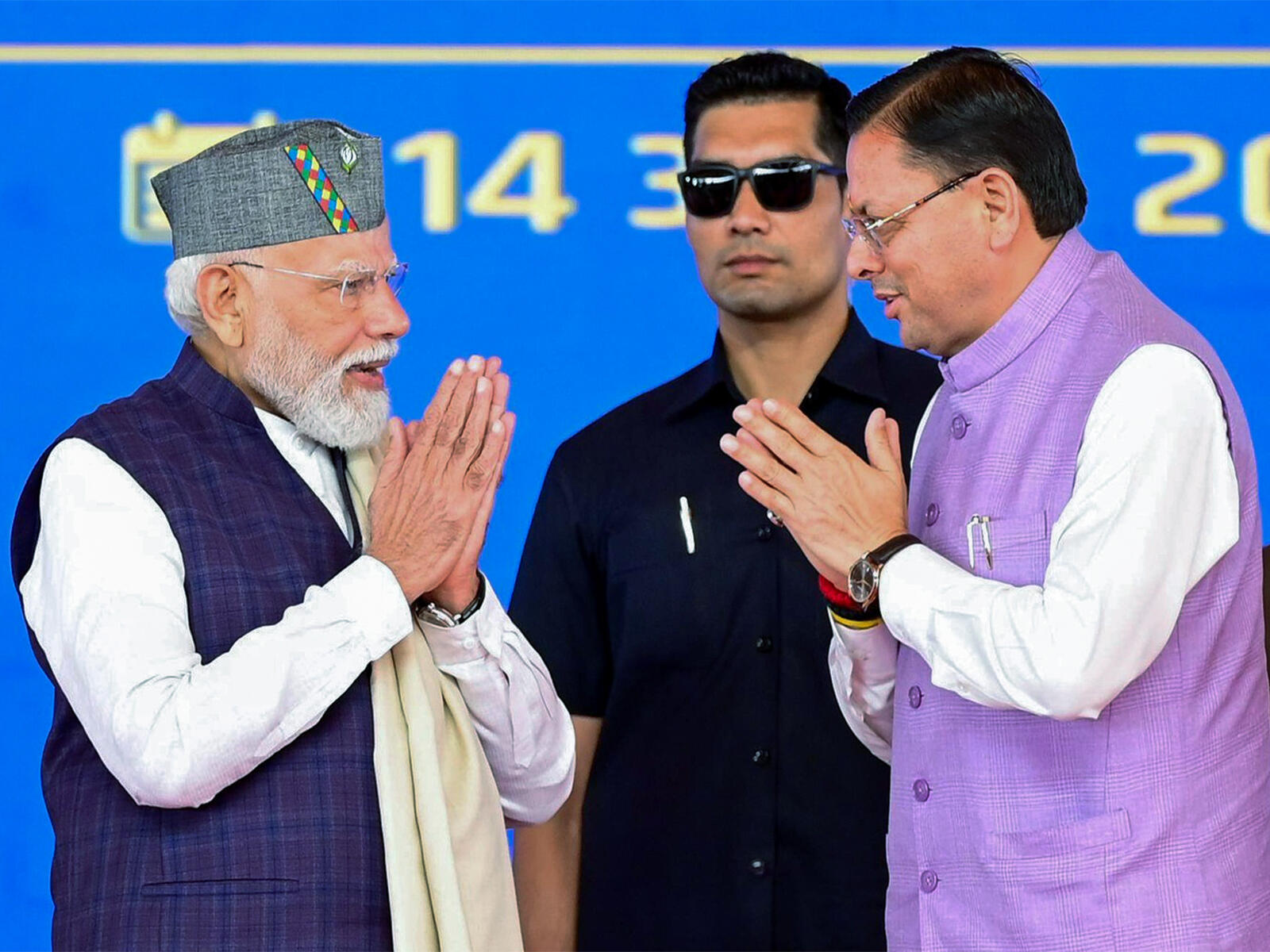
File photo: CM Dhami hails PM Modi’s leadership as Uttarakhand celebrates State Foundation Day
The party is also working to consolidate its social coalition across the state’s varied electorate. Uttarakhand’s political arithmetic includes upper-caste communities, particularly Brahmins and Rajputs, Scheduled Castes, OBC groups, and communities in the Terai and plains with distinct local and regional interests. The BJP’s challenge is to retain its existing support while expanding its appeal among groups where the Congress and other parties remain competitive. Its outreach to Dalit communities has acquired particular visibility amid the political dispute over the alleged purification ritual at Haldwani’s Ramlila Maidan after Congress president Mallikarjun Kharge’s rally. Both parties have sought to engage Scheduled Caste voters in the aftermath of the controversy.Women and younger voters are also important to the party’s calculations. Reports on the BJP’s preparations suggest that it is considering additional welfare announcements aimed at women, alongside measures to address youth employment and migration. Its outreach has also included ex-servicemen and members of the Sikh community.The BJP’s development narrative is closely linked to its emphasis on religious identity and pilgrimage infrastructure. The Uniform Civil Code, implemented in January 2025, is among the Dhami government’s most prominent policy initiatives. The party has also highlighted the development of religious sites, expansion of tourism infrastructure and preparations for the Haridwar Kumbh.Organisation is set to be another pillar of their strategy, during his September visit to Haldwani, Nabin called on party workers to strengthen the booth-level network and work towards winning every booth. Their emphasis is not simply on mobilising workers closer to polling day, but on maintaining contact with voters, communicating government schemes and identifying constituencies where the party needs to improve its performance.The party is also considering a generational reset in its candidate selection. A TOI report said the BJP is weighing a greater emphasis on younger leaders and women, with performance, voter connect, public acceptance and organisational strength likely to determine ticket allocation. The party has conducted surveys to assess its sitting MLAs, and internal discussions suggest that 20-25% of them could lose their tickets if they receive poor feedback from their constituencies. State BJP president Mahendra Bhatt has maintained that winnability will be the key criterion.The BJP has also sought to make voter-list revision part of its political messaging around identity and demographic change. At a party meeting in Dehradun in June, state president Mahendra Bhatt urged workers to participate actively in the revision of electoral rolls and ensure that those the party described as “infiltrators” and other ineligible persons were removed. “Only the original people of Devbhoomi should decide the government,” he said. The remarks reflect how the BJP is linking its appeal around Uttarakhand’s cultural identity with questions of who belongs in the state and who should shape its political future.Taken together, these moves show that the BJP is approaching 2027 with a campaign built around continuity, development, cultural identity and a tighter electoral organisation. But a third term will depend on whether these themes can hold up against the everyday concerns of voters. Questions of jobs, recruitment, migration, land rights and public services are unlikely to disappear simply because the party has sharpened its campaign machinery. For the BJP, the challenge is not only to make history, but to prevent local discontent from becoming a vote against it.
Congress wants a comeback. But can it get its house in order?
The Congress did improve their performance in the 2022 elections but the reality is that they still lost. To make a comeback in the region, Congress will have to not only identify local discontent and areas of vulnerability, but also build a campaign that can carry those issues across the state and maintain coordination among leaders with competing political interests.The party has begun its organisational preparations. On November 2, Congress president Mallikarjun Kharge and Rahul Gandhi met senior Uttarakhand leaders in New Delhi, including state unit chief Ganesh Godiyal, leader of the opposition Yashpal Arya and senior leaders Pritam Singh and Harak Singh Rawat. Congress general secretary (organisation) K C Venugopal and state in-charge Kumari Selja also attended the meeting, which focused on the party’s strategy for the 2027 assembly elections.The meeting was accompanied by a sharper attack on the BJP government. Kharge accused the state government of failing on law and order, women’s safety and accountability, while Venugopal raised allegations of corruption, land grabs, environmental mismanagement and irregularities in recruitment examinations. The party also invoked the Ankita Bhandari case, which is sure to take centre stage in their rejection of the Centre.Issues Congress is likely to raise in its election campaign:Ankita Bhandari murder case: The murder of 19-year-old Ankita Bhandari in September 2022 remains one of the most politically sensitive issues in Uttarakhand. Bhandari, who worked as a receptionist at the Vanantra resort near Rishikesh, was murdered by resort owner Pulkit Arya and two employees. All three were convicted and sentenced to life imprisonment in May 2025. But the convictions have not brought an end to the family’s campaign for answers about the alleged involvement of an influential person, referred to as a “VIP”, in the circumstances leading to her murder.The controversy has acquired a more direct political dimension because Ankita’s parents have publicly named BJP leader Dushyant Kumar Gautam in their allegations. Gautam, who was appointed governor of Sikkim in October, has denied any involvement and initiated defamation proceedings against those accusing him. The family has demanded that his appointment be put on hold until the investigation into the alleged VIP angle is completed.
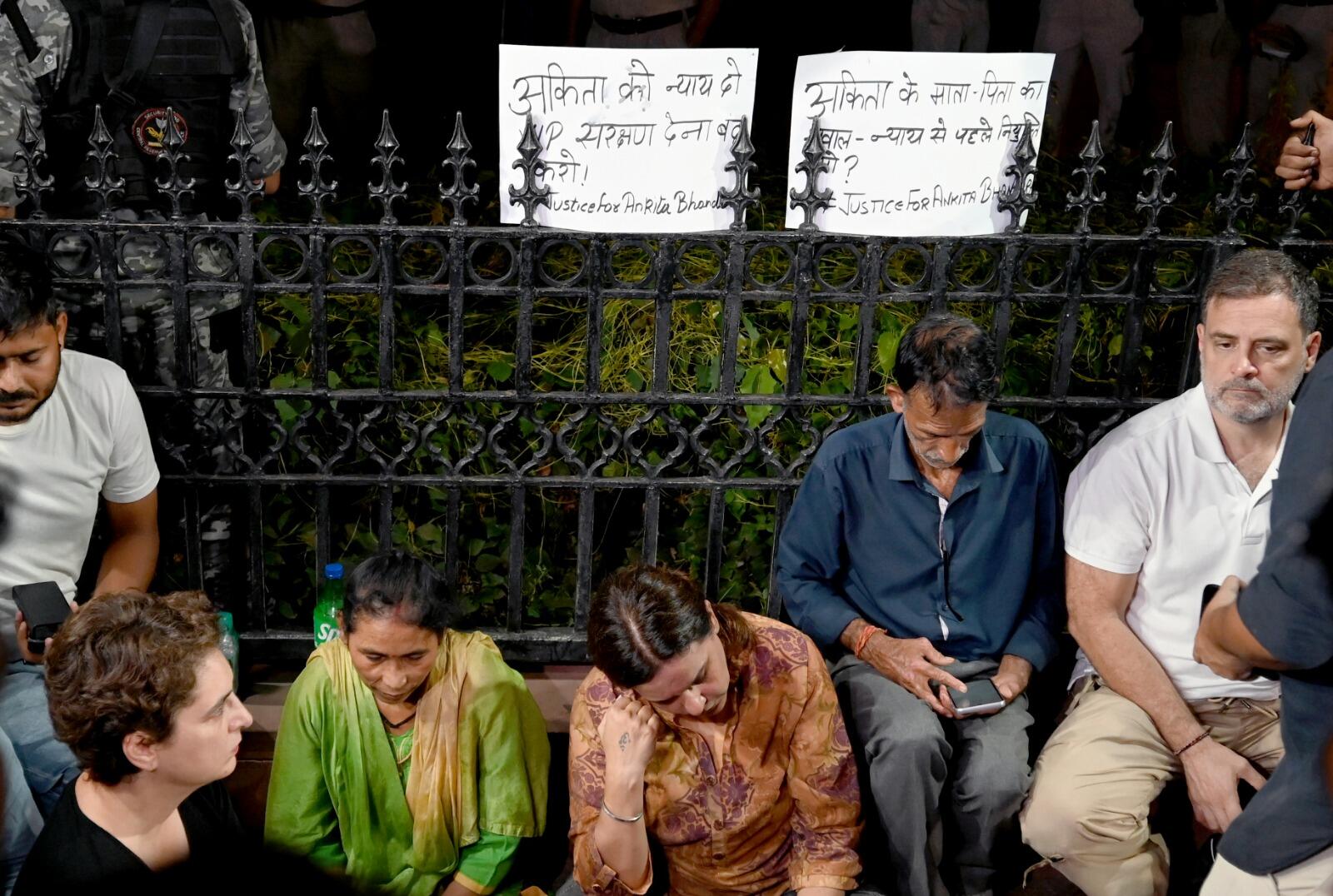
File photo: Leader of opposition in the Lok Sabha Rahul Gandhi sits with the parents of Ankita Bhandari during a sit-in protest at India Gate in New Delhi
The family’s protests have also brought the case back into the national political spotlight. On October 14, Rahul Gandhi and Priyanka Gandhi Vadra joined Ankita’s parents at a sit-in near India Gate, where the family was protesting against Gautam’s appointment. Hours later, Delhi Police detained the parents and several Congress leaders; they were released the following morning. On November 4, the parents staged another sit-in near Rajghat and were removed by police.For the Congress, the case has become a prominent part of its challenge to the BJP government on women’s safety and accountability. For the ruling party, the continuing protests and the questions raised by Ankita’s family have kept an unresolved controversy in public view, even after the murder trial concluded. As the state approaches another election, the issue is no longer limited to the crime itself; it also concerns the credibility and progress of the investigation into the alleged VIP angle, the family’s demand for answers and the government’s response to their campaign.Jobs and recruitment: The cancellation of the Uttarakhand Subordinate Services Selection Commission’s graduate-level examination in September 2025, after a paper leak was confirmed at an examination centre in Haridwar, renewed questions about the credibility of the recruitment process. More than one lakh candidates had appeared for an examination for 416 posts, and the cancellation triggered protests. The episode also raised questions about the implementation of the state’s 2023 anti-cheating law, which had been introduced after earlier recruitment controversiesMigration: People leave remote hill villages not only for jobs, but also for better access to education, healthcare, transport and other basic services. The government has cited efforts to encourage reverse migration, but claims of improvement need to be measured against reliable data on village populations, employment and public services. The issue is not simply whether people are returning, but whether they can build sustainable lives in the hills.Land laws: The 2025 amendment to Uttarakhand’s land laws restricted the purchase of agricultural and horticultural land by people from outside the state in 11 hill districts. While the government has presented this as a measure to protect local interests, campaigners argue that exemptions and the treatment of urban areas leave important gaps.The debate reflects a wider concern over local control of land and resources, and whether the aspirations behind Uttarakhand’s creation in 2000 have been fulfilled. Gairsain, designated as the summer capital, remains central to this discussion, particularly for those who believe development and administration have yet to reach remote hill regions.The Uttarakhand Kranti Dal (UKD), closely associated with the statehood movement, continues to represent some of these concerns. It had four MLAs in the first Assembly in 2002, but its representation declined sharply in subsequent elections. Its decision to field candidates in 2027 signals an attempt to reclaim the debate over regional identity and local rights, though its electoral influence remains limited.Regional and electoral arithmetic: Uttarakhand’s politics is shaped by differences between Garhwal and Kumaon, as well as the plains and Terai. The identities and local concerns of Garhwalis and Kumaonis form part of the state’s political landscape, but they do not translate into fixed voting blocs. Employment, migration, land rights, infrastructure and access to public services can carry different weight across districts. The plains and Terai, meanwhile, have distinct demographic and economic dynamics. Congress will need to build a campaign that addresses these regional differences rather than assume that a single statewide message will resonate equally across all 70 constituencies.But the most dire step that Congress needs to take is to reconcile its senior leadership with the push for a more coordinated and visible state unit. The party can raise all the issues they want but unlike the BJP, they no longer have an established face to lead their campaigns. To put it lightly, their established faces have lost face during the previous elections.The BJP has already made Congress’s internal differences part of its political argument. The Congress, in turn, is seeking to make governance and accountability the focus of the contest. Whether it can sustain that approach through a coordinated campaign, a stronger presence across constituencies and a clear leadership structure will be one of the defining questions of 2027.
Share your thoughts in the comments
Be respectful · TOI community guidelines
What the 2027 contest will turn on
The BJP is seeking to make the election a referendum on continuity: its record in office, the leadership of Pushkar Singh Dhami, infrastructure development, welfare and the UCC.The Congress is trying to frame the election around accountability, employment, recruitment, migration, land and women’s safety.But the contest will ultimately be shaped by how voters across the state assess these competing claims. The BJP has the advantage of an established organisation and a second consecutive term behind it. The Congress has a list of grievances it hopes to turn into a campaign, but must still demonstrate that it can offer a coordinated alternative.The hills have eyes. They have watched governments come and go, and now they decide who they watch for the next 5 years.