








Headlines

Argentina’s mysterious floating island named ‘EL Ojo’ that appears to rotate on its own in perfect circular motion  | World News

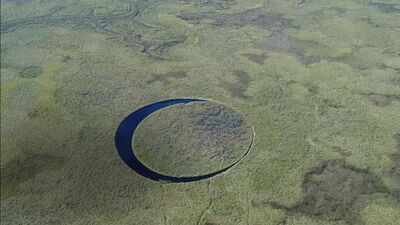
Aerial view of El Ojo island. Image Credit: Argentina Government El Ojo, a remarkably circular floating island in Argentina’s Paraná Delta, has become one of the region’s strangest natural sights. Measuring about 120 metres across, the island sits inside an almost perfectly circular body of water and appears to move independently of the surrounding wetlands….


Read More

Atolls can take up to 30 million years to form, but these tiny coral islands now support 31 million seabirds across the Indo-Pacific |

Atolls can take up to 30 million years to form, but these tiny coral islands now support 31 million seabirds across the Indo-Pacific (PC: AI Generated) Atolls may look like tiny rings of sand and coral scattered across warm tropical oceans, but they are far more important than their small land areas. These unusual natural…

Read More

In 1745, the US welcomed mimosa trees for their pink flowers; they later escaped gardens and spread as an invasive species | World News

Around 1745, mimosa arrived in the United States as an ornamental tree, prized for its fragrant pink flowers, delicate foliage and unusual habit of folding its leaves at night. What began as a garden favourite, however, did not stay neatly within gardens. Albizia julibrissin escaped cultivation and gradually established itself along roadsides, clearings, flood plains…

Read More

In 2024, a beaver returned to a California creek after 19 years and began cutting down aspen trees beside a man-made dam | World News

For nearly two decades, there was no sign of beavers along Strawberry Creek in Great Basin National Park. Then, in 2024, park staff discovered evidence that one had returned, several quaking aspen trees had been freshly cut down beside a beaver dam analogue, a human-built structure designed to imitate the ecological effects of a natural…

Read More

Meet Rohan Naidu, the MIT astronomer who left engineering at 18; now he is helping uncover how the Universe’s earliest black holes formed

Image(s): Left/Department of Physics, MIT/Right/MoM-BH*-1 A Hyderabad-born astronomer who left engineering school at 18 and counts Test cricket among his favourite pastimes is now helping scientists look deeper into the earliest chapters of the Universe. Rohan P. Naidu, an MIT Pappalardo Fellow in Physics, is the lead author of a new Nature study that examines…

Read More

Scientists are saying that universe may not last forever because Hawking-like radiation could eventually cause its evaporation |

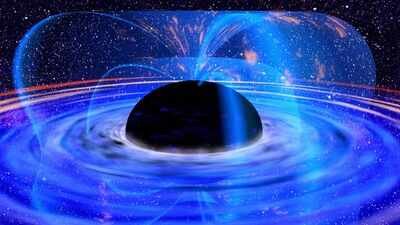
Supermassive black holes are expected to outlast proton decay, but will eventually evaporate completely. Image Credit: D. Berry/Nasa Earth is expected to remain alive for an almost unimaginable length of time, but new calculations suggest that even massive objects could eventually disappear through a process similar to Hawking radiation. Scientists at Radboud University in the…

Read More

nasa aircraft are chasing giant fire clouds over utah: these towering smoke-filled clouds can punch high into earth’s atmosphere |

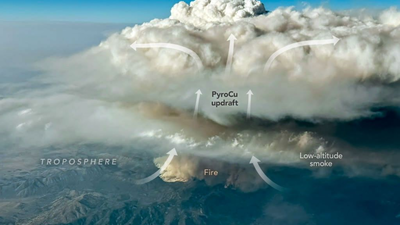
A wildfire in Utah has become the focus of an unusual airborne investigation, after towering clouds of smoke and hot air pushed towards the upper reaches of the atmosphere. Nasa aircraft are chasing these smoke-filled formations to understand what happens when an intense fire effectively starts generating its own weather. The clouds, known as pyrocumulonimbus…

Read More

Quote of the day by Stephen Hawking: “However difficult life may seem, there is always…” – a lesson on resilience, perspective and finding what remains possible |

Stephen Hawking‘s words offer a genuinely powerful reminder that a difficult situation rarely means every single possibility has actually disappeared. “However difficult life may seem, there is always something you can do and succeed at,” he said. “It matters that you don’t just give up.” He said this in a speech to the Oxford Union…

Read More

Meet Astrid Eeuwes: The Dutch amateur astronomer who studies tiny space dust and now has an asteroid named after her |

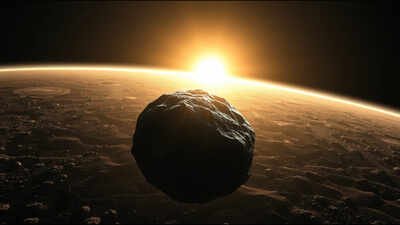
Representative Image of asteroid (585349) Eeuwes traveling through the main asteroid belt between Mars and Jupiter (AI-generated image) A 1.5-kilometre asteroid orbiting the Sun between Mars and Jupiter now carries the name of Astrid Eeuwes, a Dutch amateur astronomer from Nijmegen who spends much of her time studying micrometeorites, tiny particles of space material that…

Read More